Friday, February 19, 2016

BLACK PANTHER vs KKK

BLACK PANTHER

 In late October 1966, Huey P. Newton and Bobby Seale founded the Black Panther Party (originally the Black Panther Party for Self-Defense). In formulating a new politics, they drew on their experiences working with a variety of Black Power organizations. Newton and Seale first met in 1962 when they were both students at Merritt College.


October 15, 1966, the Black Panther Party's core practice was its armed citizens' patrols to monitor the behavior of police officers and challenge police brutality in Oakland, California. In 1969, community social programs became a core activity of party members.The Black Panther Party instituted a variety of community social programs, most extensively the Free Breakfast for Children Programs, and community

Federal Bureau of Investigation Director J. Edgar Hoover called the party "the greatest threat to the internal security of the country", and he supervised an extensive program (COINTELPRO) of surveillance, infiltration, perjury, police harassment, and many other tactics designed to undermine Panther leadership, incriminate party members, discredit and criminalize the Party, and drain the organization of resources and manpower. The program was also accused of using assassination against Black Panther members

Government oppression initially contributed to the growth of the party as killings and arrests of Panthers increased support for the party within the black community 

In August 1967, the Federal Bureau of Investigation (FBI) instructed its program "COINTELPRO" to "neutralize" what the FBI called "black nationalist hate groups" and other dissident groups. In September 1968, FBI Director J. Edgar Hoover described the Black Panthers as "the greatest threat to the internal security of the country". By 1969, the Black Panthers and their allies had become primary COINTELPRO targets, singled out in 233 of the 295 authorized "Black Nationalist" COINTELPRO actions. The goals of the program were to prevent the unification of militant black nationalist groups and to weaken the power of their leaders, as well as to discredit the groups to reduce their support and growth. The initial targets included the Southern Christian Leadership Conference, the Student Nonviolent Coordinating Committee, the Revolutionary Action Movement and the Nation of Islam. Leaders who were targeted included the Rev. Martin Luther King, Jr., Stokely Carmichael, H. Rap Brown, Maxwell Stanford and Elijah Muhammad.
Part of the COINTELPRO actions were directed at creating and exploiting existing rivalries between black nationalist factions. One such attempt was to "intensify the degree of animosity" between the Black Panthers and the Blackstone Rangers, a Chicago street gang. They sent an anonymous letter to the Ranger's gang leader claiming that the Panthers were threatening his life, a letter whose intent was to induce "reprisals" against Panther leadership. In Southern California similar actions were taken to exacerbate a "gang war" between the Black Panther Party and a group called the US Organization. It was alleged that the FBI had sent a provocative letter to the US Organization in an attempt to increase existing antagonism between US and the Panthers.
COINTELPRO also aimed to dismantle the Black Panther Party by targeting the social/community programs they endorsed, one of the most influential being the Free Breakfast for Children Program. The success of the Free Breakfast for Children Program served to "shed light on the government's failure to address child poverty and hunger—pointing to the limits of the nation's War on Poverty". The ability of the Party to organize and provide for children more effectively than the U.S. government led the FBI to criticize the program as a means of exposing children to Panther Propaganda. In response to this, as an effort of disassembling the program, "Police and Federal Agents regularly harassed and intimidated program participants, supporters, and Party workers and sought to scare away donors and organizations that housed the programs like churches and community centers"

In Chicago, on December 4, 1969, two Panthers were killed when the Chicago Police raided the home of Panther leader Fred Hampton. The raid had been orchestrated by the police in conjunction with the FBI. Hampton was shot and killed, as was Panther guard Mark Clark. A federal investigation reported that only one shot was fired by the Panthers, and police fired at least 80 shots. Hampton was subsequently shot twice in the head at point blank range while unconscious. He was 21 years old and unarmed at the time of his death. Coroner reports show that Hampton was drugged with a powerful barbiturate that night and all indicators point toward FBI infiltrator William O'Neal as the source of the drugging. Former FBI agent Wesley Swearingen asserts that the Bureau was guilty of a "plot to murder" the Panthers. Cook County State's Attorney Edward Hanrahan, his assistant and eight Chicago police officers were indicted by a federal grand jury over the raid, but the charges were later dismissed. In 1979 civil action, Hampton's family won $1.85 million from the city of Chicago in a wrongful death settlement

KKK
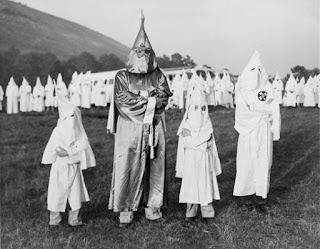


The Ku Klux Klan (KKK), or simply "the Klan", is the name of three distinct past and present movements in the United States that have advocated extremist reactionary currents such as white supremacy, white nationalism, and anti-immigration, historically expressed through terrorism aimed at groups or individuals whom they opposed. All three movements have called for the "purification" of American society, and all are considered right wing extremist organizations.
The first Ku Klux Klan flourished in the Southern United States in the late 1860s, then died out by the early 1870s. It sought to overthrow the Republican state governments in the South during the Reconstruction Era, especially by using violence against African American leaders. With numerous chapters across the South, it was suppressed around 1871, through federal enforcement. Members made their own, often colorful, costumes: robes, masks, and conical hats, designed to be terrifying, and to hide their identities.[11][12]
The second group was founded in 1915, and flourished nationwide in the early and mid-1920s, particularly in urban areas of the Midwest and West. It opposed Catholics and Jews, especially newer immigrants, and stressed opposition to the Catholic Church. This second organisation adopted a standard white costume and used similar code words as the first Klan, while adding cross burnings and mass parades.
The third and current manifestation of the KKK emerged after 1950, in the form of small, local, unconnected groups that use the KKK name. They focused on opposition to the Civil Rights Movement, often using violence and murder to suppress activists. It is classified as a hate group by the Anti-Defamation League and the Southern Poverty Law Center. It is estimated to have between 5,000 and 8,000 members as of 2012.
The second and third incarnations of the Ku Klux Klan made frequent reference to the America's "Anglo-Saxon" blood, hearkening back to 19th-century nativism. Though members of the KKK swore to uphold American values and Christian morality, virtually every Christian denomination officially denounced the KKK

First KKK

The first Klan was founded in Pulaski, Tennessee, some time between December 1865 and August 1866 by six former members of the Confederate army[17] as a fraternal social club inspired at least in part by the then largely defunct Sons of Malta, from which parts of the initiation ceremony were borrowed, with the same purpose: "ludicrous initiations, the baffling of public curiosity, and the amusement for members were the only objects of the Klan."[18] The name is probably derived from the Greek word kuklos (κύκλος) which means circle.[19]
According to The Cyclopædia of Fraternities (1907) "Beginning in April, 1867, there was a gradual transformation... The members had conjured up a veritable Frankenstein. They had played with an engine of power and mystery, though organized on entirely innocent lines, and found themselves overcome by a belief that something must lie behind it all—that there was, after all, a serious purpose, a work for the Klan to do."[18]
Although there was little organizational structure above the local level, similar groups rose across the South and adopted the same name and methods. Klan groups spread throughout the South as an insurgent movement during the Reconstruction era in the United States. As a secret vigilante group, the Klan targeted freedmen and their allies; it sought to restore white supremacy by threats and violence, including murder, against black and white Republicans. In 1870 and 1871, the federal government passed the Enforcement Acts, which were successfully enforced in prosecuting and suppressing Klan crimes.
The first Klan had mixed results in terms of achieving its objectives. It seriously weakened the black political establishment through its use of assassinations and threats of violence; it drove some people out of politics. On the other hand, it caused a sharp backlash, with passage of federal laws that historian Eric Foner says were a success in terms of "restoring order, reinvigorating the morale of Southern Republicans, and enabling blacks to exercise their rights as citizens." Historian George C. Rable argues that the Klan was a political failure and therefore was discarded by the Democratic leaders of the South. He says:
the Klan declined in strength in part because of internal weaknesses; its lack of central organization and the failure of its leaders to control criminal elements and sadists. More fundamentally, it declined because it failed to achieve its central objective – the overthrow of Republican state governments in the South

Second KKK


In 1915, the second Klan was founded in Atlanta, Georgia. Starting in 1921, it adopted a modern business system of using full-time paid recruiters and appealed to new members as a fraternal organization, of which many examples were flourishing at the time. The national headquarters made its profit through a monopoly of costume sales, while the organizers were paid through initiation fees. It grew rapidly nationwide at a time of prosperity. Reflecting the social tensions pitting urban versus rural America, it spread to every state and was prominent in many cities. The second KKK preached "One Hundred Percent Americanism" and demanded the purification of politics, calling for strict morality and better enforcement of prohibition. Its official rhetoric focused on the threat of the Catholic Church, using anti-Catholicism and nativism.[3] Its appeal was directed exclusively at white Protestants; it opposed Jews, blacks, Catholics, and newly arriving Southern European groups such as Italians.[24] Some local groups threatened violence against rum runners and notorious sinners; the violent episodes generally took place in the South.
The second Klan was a formal fraternal organization, with a national and state structure. At its peak in the mid-1920s, the organization claimed to include about 15% of the nation's eligible population, approximately 4–5 million men. Internal divisions, criminal behavior by leaders, and external opposition brought about a collapse in membership, which had dropped to about 30,000 by 1930. It finally faded away in the 1940s.Klan organizers also operated in Canada, especially in Saskatchewan in 1926-28, where Klansmen denounced immigrants from Eastern Europe as a threat to Canada's British heritage


Third KKK

The "Ku Klux Klan" name was used by numerous independent local groups opposing the Civil Rights Movement and desegregation, especially in the 1950s and 1960s. During this period, they often forged alliances with Southern police departments, as in Birmingham, Alabama; or with governor's offices, as with George Wallace of Alabama. Several members of KKK groups were convicted of murder in the deaths of civil rights workers in Mississippi in 1964 and children in the bombing of the 16th Street Baptist Church in Birmingham in 1963. Today, researchers estimate that there may be 150 Klan chapters with upwards of 5,000 members nationwide.
Today, many sources classify the Klan as a "subversive or terrorist organization".[31][32][33][34] In April 1997, FBI agents arrested four members of the True Knights of the Ku Klux Klan in Dallas for conspiracy to commit robbery and conspiring to blow up a natural gas processing plant. In 1999, the city council of Charleston, South Carolina passed a resolution declaring the Klan to be a terrorist organization In 2004, a professor at the University of Louisville began a campaign to have the Klan declared a terrorist organization in order to ban it from campus.


Klan members adopted masks and robes that hid their identities and added to the drama of their night rides, their chosen time for attacks. Many of them operated in small towns and rural areas where people otherwise knew each other's faces, and sometimes still recognized the attackers by voice and mannerisms. "The kind of thing that men are afraid or ashamed to do openly, and by day, they accomplish secretly, masked, and at night."[52] The KKK night riders "sometimes claimed to be ghosts of Confederate soldiers so, as they claimed, to frighten superstitious blacks. Few freedmen took such nonsense seriously."[53]
The Klan attacked black members of the Loyal Leagues and intimidated southern Republicans and Freedmen's Bureau workers. When they killed black political leaders, they also took heads of families, along with the leaders of churches and community groups, because these people had many roles in society. Agents of the Freedmen's Bureau reported weekly assaults and murders of blacks.
"Armed guerrilla warfare killed thousands of Negroes; political riots were staged; their causes or occasions were always obscure, their results always certain: ten to one hundred times as many Negroes were killed as whites." Masked men shot into houses and burned them, sometimes with the occupants still inside. They drove successful black farmers off their land. "Generally, it can be reported that in North and South Carolina, in 18 months ending in June 1867, there were 197 murders and 548 cases of aggravated assault."

                                           George W. Ashburn was assassinated for his pro-black sentiments.
Klan violence worked to suppress black voting, and campaign seasons were deadly. More than 2,000 persons were killed, wounded and otherwise injured in Louisiana within a few weeks prior to the Presidential election of November 1868. Although St. Landry Parish had a registered Republican majority of 1,071, after the murders, no Republicans voted in the fall elections. White Democrats cast the full vote of the parish for President Grant's opponent. The KKK killed and wounded more than 200 black Republicans, hunting and chasing them through the woods. Thirteen captives were taken from jail and shot; a half-buried pile of 25 bodies was found in the woods. The KKK made people vote Democratic and gave them certificates of the fact.[55]
In the April 1868 Georgia gubernatorial election, Columbia County cast 1,222 votes for Republican Rufus Bullock. By the November presidential election, Klan intimidation led to suppression of the Republican vote and only one person voted for Ulysses S. Grant.[56]
Klansmen killed more than 150 African Americans in a county in Florida, and hundreds more in other counties. Freedmen's Bureau records provided a detailed recounting of Klansmen's beatings and murders of freedmen and their white allies

 By 1868, two years after the Klan's creation, its activity was beginning to decrease.[59] Members were hiding behind Klan masks and robes as a way to avoid prosecution for freelance violence. Many influential southern Democrats feared that Klan lawlessness provided an excuse for the federal government to retain its power over the South, and they began to turn against it.[60] There were outlandish claims made, such as Georgian B. H. Hill stating "that some of these outrages were actually perpetrated by the political friends of the parties slain

In the mid-1870s, new groups of insurgents, local paramilitary organizations such as the White League, Red Shirts, saber clubs, and rifle clubs, emerged, continuing to intimidate and murder black political leaders.[80] The White League and Red Shirts were distinguished by their willingness to cultivate publicity, working directly to overturn Republican officeholders and regain control of politics.


Goals

The Second Klan saw threats from every direction. A religious tone was present in its activities: "two-thirds of the national Klan lecturers were Protestant ministers," says historian Brian R. Farmer.[89] Much of the Klan's energy went into guarding "the home;" the historian Kathleen Blee said its members wanted to protect "the interests of white womanhood."[90] The pamphlet ABC of the Invisible Empire, published in Atlanta by Simmons in 1917, identified the Klan's goals as "to shield the sanctity of the home and the chastity of womanhood; to maintain white supremacy; to teach and faithfully inculcate a high spiritual philosophy through an exalted ritualism; and by a practical devotedness to conserve, protect and maintain the distinctive institutions, rights, privileges, principles and ideals of a pure Americanism


Costumes and a burning cross

The distinctive white costume permitted large-scale public activities – especially parades and cross-burning ceremonies while keeping secret the membership rolls. Sales of the costumes provided the main financing for the national organization, while initiation fees funded local and state organizers.
The second Klan embraced a burning Latin cross as a dramatic display of symbolism, with a tone of intimidation.[109] No crosses had been used as a symbol by the first Klan. Additionally, the cross was henceforth a representation of the Klan's Christian message. Thus, its lighting during meetings was often accompanied by prayer, the singing of hymns, and other overtly religious symbolism.[110]
In The Clansman novel Dixon had invented the notion that the first Klan had used fiery crosses. Film director Griffith brought this image to the screen in The Birth of a Nation. Simmons adopted the symbol wholesale from the movie. The symbol has been associated with the Klan ever since

Thursday, February 11, 2016

SPORTS SLAVERY (NUMBERS NEVER LIE)

NFL

5 out of 32 head coaches are black but More Than 2/3 (68 percent) of NFL Players are African-American 

Of the 175 cornerbacks in the league, 170 are black. At running back, 107 of the 120 players are African-American.

NBA

 10 of 30 head coaches are black while almost 82% are black (2014 data)

 MLB 

The baseball rosters on opening day 2013 featured 8.2 percent of players who identified as African-American. There are only 2 black managers


Monday, December 21, 2015

Numbers Don't Lie {top 10 poverty states}

MISSISSIPPI
Poverty rate: 24.1%
Mississippi is the poorest state in the US, with 695,915 people living below the poverty line. It also ranks last in its rate of child poverty (33.7%), and next to last in hunger and food insecurity. Mississippi — along with Louisiana, Alabama, Tennessee, and South Carolina — has no state minimum wage, but the unemployed are largely covered by state welfare program
Refused Obama care
states With Highest Death Rates by Police ranked 4  
States with the highest reported misconduct per 100,000 officer:ranked 3. Mississippi: 1735.28 
Most Conservative state Ranked #1


State with the top incarceration rated ranked # 2

 NEW MEXICO
Poverty rate: 22%
In New Mexico, 31% of children live in poverty, and many of them are homeless. New Mexico has the highest teen birth rate in the country, with 47.5 births per 1,000 women ages 15 to 19 in 2012. But the state ranks eighth-best for number children living with their parents: only four in every 1,000 live in foster care. New Mexico has been slow to recover from the national recession. In 2012 alone, 3,900 people working in the public sector lost their jobs.


 LOUISIANA
Poverty rate: 19.8%
Louisiana is the most unequal state in the country in terms of its gender wage gap: women earned just 66% of what men earned in 2013. Louisiana is also the third most unequal state overall: in 2013, the share of income going to the top 20% of households in Louisiana was 18.5 times that going to the bottom 20%. Its unemployment rate, however, is fairly low, at 6.2%.
 Refused Obama care
states With Highest Death Rates by police ranked 9
States with the highest reported misconduct per 100,000 officers:ranked 1. Louisiana: 1777.38
 Most conservative state Ranked #3
 State with the top incarceration rated ranked #1

GEORGIA
Poverty rate: 19%
Almost two million Georgians currently live below the poverty line, and 21% of residents ages 18 to 24 were not in school or working as of 2012. Benefits are scarce: 84% of unemployed workers in Georgia do not receive any kind of unemployment insurance — even as poverty is soaring, fewer than 4,000 adults in Georgia receive welfare
 Refused Obama care 
states With Highest Death Rates by police ranked 7 with 6.8

WASHINGTON
Poverty rate: 18.9%
Washington, D.C. has the highest level of income inequality in the country: in 2013, the share of income going to the top 20% of households in Washington, D.C. was 30.3 times the share received by the bottom 20%. Only 59% of high school students graduated in 2012 — the national average is just over 80%. D.C. adults ages 25-24 are among the most educated in the country, however, with 70.2% having obtained an associate's degree or higher as of 2012
states with the highest foreclosure rank #4

 KENTUCKY
Poverty rate: 18.8%
At just over 8%, Kentucky's unemployment rate is one of the highest in the country. The eastern Kentucky counties of Clay, Jackson, Lee, and Leslie have fared particularly poorly: the unemployment rate in Clay County is 12.7% and only 7.4% of the population has a bachelor’s degree or higher, The New York Times reported.
Refused Obama care 

ALABAMA
Poverty rate: 18.7%
More than one in four children live in poverty in this rural Southern state. From 2011 to 2013, 16.7% of Alabama households were food insecure, meaning they struggled to provide enough food for their families. Nearly one million Alabamians were dependent on food stamps in 2013, the Montgomery Advertiser reported
 Refused Obama care
 State with the top incarceration rated ranked #3

ARIZONA
Poverty rate: 18.6%
Much like Georgia, the percentage of unemployed Arizonians receiving welfare from the state is very low. As of 2012, almost one in five young people ages 18-24 were neither in school nor working. Despite Arizona's high rate of poverty and unemployment, only 6.7% of unemployed workers in Arizona were helped by unemployment insurance in 2013.


SOUTH CARILINA
Poverty rate: 18.6%
South Carolina has one of the highest rates of child poverty in the country, with 27.3% of children living below the poverty line in 2013. South Carolina's median household income was $23,906 in 2012, and it was even less for African Americans ($15,398) and Hispanics ($13,681), according to the South Carolina Revenue and Fiscal Affairs office.
 Refused Obama care
 Most conservative state Ranked # 10
 states with the highest foreclosure rank #10

WEST VIRGINIA
Poverty rate: 18.5%
West Virginia has traditionally relied on its mining industry for jobs and growth. But as mining jobs become increasingly scarce, West Virginians — many of whom never obtained a college degree — are finding themselves stuck. Only 31.3% of young adults ages 25 to 34 had an associate's degree or higher as of 2012, and women earn far less than men. In 2013, women’s median earnings were 69% those of me
rates with the highest reported misconduct per 100,000 officers:ranked  ranked 4. 

 Mississippi, Louisiana, Alabama, Tennessee, and South Carolina — has no state minimum wage, but the unemployed are largely covered by state welfare program

Saturday, November 7, 2015

Cheney's Halliburton Made $39.5 Billion on Iraq War By Angelo Young, International Business Times

he accounting of the financial cost of the nearly decade-long Iraq War will go on for years, but a recent analysis has shed light on the companies that made money off the war by providing support services as the privatization of what were former U.S. military operations rose to unprecedented levels.
Private or publicly listed firms received at least $138 billion of U.S. taxpayer money for government contracts for services that included providing private security, building infrastructure and feeding the troops.
Ten contractors received 52 percent of the funds, according to an analysis by the Financial Times that was published Tuesday.
The No. 1 recipient?
Houston-based energy-focused engineering and construction firm KBR, Inc. (NYSE:KBR), which was spun off from its parent, oilfield services provider Halliburton Co. (NYSE:HAL), in 2007.
The company was given $39.5 billion in Iraq-related contracts over the past decade, with many of the deals given without any bidding from competing firms, such as a $568-million contract renewal in 2010 to provide housing, meals, water and bathroom services to soldiers, a deal that led to a Justice Department lawsuit over alleged kickbacks, as reported by Bloomberg.
Who were Nos. 2 and 3?
Agility Logistics (KSE:AGLTY) of Kuwait and the state-owned Kuwait Petroleum Corp. Together, these firms garnered $13.5 billion of U.S. contracts.
As private enterprise entered the war zone at unprecedented levels, the amount of corruption ballooned, even if most contractors performed their duties as expected.
According to the bipartisan Commission on Wartime Contracting in Iraq and Afghanistan, the level of corruption by defense contractors may be as high as $60 billion. Disciplined soldiers that would traditionally do many of the tasks are commissioned by private and publicly listed companies.
Even without the graft, the costs of paying for these services are higher than paying governement employees or soldiers to do them because of the profit motive involved. No-bid contracting - when companies get to name their price with no competing bid - didn't lower legitimate expenses. (Despite promises by President Barack Obama to reel in this habit, the trend toward granting favored companies federal contracts without considering competing bids continued to grow, by 9 percent last year, according to the Washington Post.)
Even though the military has largely pulled out of Iraq, private contractors remain on the ground and continue to reap U.S. government contracts. For example, the U.S. State Department estimates that taxpayers will dole out $3 billion to private guards for the government's sprawling embassy in Baghdad.
The costs of paying private and publicly listed war profiteers seem miniscule in light of the total bill for the war.
Last week, the Costs of War Project by the Watson Institute for International Studies at Brown University said the war in Iraq cost $1.7 trillion dollars, not including the $490 billion in immediate benefits owed to veterans of the war and the lifetime benefits that will be owed to them or their next of ki

The Butcher of Congo: King Leopold II of Belgium By Andre C James


King Leopold II of Belgium was responsible for the deaths and mutilation of 10 million Congolese Africans during the late 1800’s. The spoils of modern day Belgium owes much to the people of the Congo River Basin. In a testament to the hideous brutality of the European colonial era and imperialism in its finest form, during the 1880s, when Europe was busy dividing up the continent of Africa like a vast chocolate cake, King Leopold II of Belgium laid personal claim to the largely uncharted Congo Free State. The 905,000 square miles (76 times larger than Belgium) of African rainforest held a vast fortune in rubber plantations, a commodity in high demand in late 19th century industrial Europe. Dark hearted Leopold II In 1876, Leopold formed the philanthropic organisation “Association Internationale Africaine“ (International African Association) and became its single shareholder. Under the guise of missionary work and westernisation of African peoples, Leopold II used the International African Association to further his ambitions of empire building in the hope if bringing international prestige to relatively small Belgium. In reality, the International African Association was a vehicle to enslave the people of the Congo River Basin and enrich Leopold II. In the 23 years (1885-1908) Leopold II ruled the Congo he massacred 10 million Africans by cutting off their hands and genitals, flogging them to death, starving them into forced labour, holding children ransom and burning villages. The ironic part of this story is that Leopold II committed these atrocities by not even setting foot in the Congo. It must be noted however, that whilst much attention has been given to Leopold’s atrocities in the Congo, in the same period acts of brutality were being committed on native peoples elsewhere in the world. Britain on the Aborigines in Australasia, the United States on native Americans and Pilipino , French on Northwest Congolese, Spanish on the north and central native Americans, Portuguese on the Angolans and Amazonians and Germans on Southwest Africans. However, so severe was the brutality of the genocide in Leopold’s Congo that many a European visitor publicly condemned Leopold and the Belgium government. The veracity of the crimes was so well known that Sir Arthur Conan Doyle penned the book, “The crime of the Congo” in 1909, highlighting the plight of the Congolese. Leopold’s contract Unable to read or write, the Congolese tribal Chiefs, unwittingly sold their tribe members into a lifetime of slavery for pieces of cloth. In return for "one piece of cloth per month to each of the undersigned chiefs, besides present of cloth in hand, they promised to freely of their own accord, for themselves and their heirs and successors for ever...give up to the said Association [set up by Leopold] the sovereignty and all sovereign and governing rights to all their territories...and to assist by labour or otherwise, any works, improvements or expeditions which the said Association shall cause at any time to be carried out in any part of these territories... All roads and waterways running through this country, the right of collecting tolls on the same, and all game, fishing, mining and forest rights, are to be the absolute property of the said Association." Severed hands Such was the brutality of Leopold’s Congo that those who failed to meet the rubber quotas set by the Belgian officers, were routinely flogged with the chicote or had their hands severed (the chicotte was a whip made out of raw, sun-dried hippopotamus hide, cut into a long sharp-edged cork-screw strip. It was applied to bare buttocks, and left permanent scars. Twenty strokes of it sent victims into unconsciousness and a 100 or more strokes were often fatal. The chicotte was freely used by both Leopold's men and the French).
Congolese posing with the severed hands of those who failed to make the daily rubber sap quota
www.wordpress.com
Leopold used a private mercenary force, Force Publique (FP), to do his terrorising and killing. White Officers commanded black soldiers many of whom were cannibals from tribes in the upper Congo and others had been kidnapped as children during raids on surrounding villages and raised in missionaries. A FP junior officer described a raid to punish a village that had protested, in the following words. “The commanding officer ordered us to cut off the heads of the men and hang them on the village palisades, also their sexual members, and to hang the women and the children on the palisade in the form of a cross."
Some survived their hands being hacked off
tintinology.poosk.com
Leopold's fortune Leopold II was at one stage reputed to be the richest man in the world with a personal fortune somewhere between $100 million and $500 million dollars (US). Most of his wealth was handed over to the Belgian government after his death. Present day Congo Present day Democratic Republic of Congo is estimated to hold $24 trillion (US) in untapped minerals, mostly diamonds. Following the independence of The Congo from Belgium in June 1960, Patrice Lumumba, leader of the Mouvement National Congolais (MNC), was elected Congo’s first democratically elected president. Ten weeks later following a coup de tat headed by General Mobutu Sese Seko, Patrice Lumumba was murdered by firing squad. Evidence has recently emerged that shows the US and Belgian government’s involvement in his murder. Mobutu who institutionalised corruption in the country apparently looted up to $4 billion (US) before he was subsequently ousted by rebel leader Laurent Kabila. Kabila was assassinated in 2001 and after a brief return to civil war, his son, Joseph Kabila became democratically elected president in 2006.

Monday, November 2, 2015

COLLEGE RACIST COVER


I be in Plattsburgh NY My daughter goes to that school and the funny thing about this is if u go to the clubs out here or see my daughter parting with these kids all u see is the same kids that help make this front page are the someones loving up our style singing along to the music we made dancing to the artist that they was disrespecting when they made this Front Page even speaking the slang we created to each other ...I aint mad at these young small minded kids I am just disappointed by the people that help raised them that why...BOXON

Sunday, November 1, 2015

GOVERNMENT FOUND GUILTY IN THE DEATH OF KING


efore scoffing at this headline, you should know that in 1999, in Memphis, Tennessee, more than three decades after MLK's death, a jury found local, state, and federal government agencies guilty of conspiring to assassinate the Nobel Peace Prize winner and civil rights leader. The same media you would expect to cover such a monumental decision was absent at the trial, because those news organizations were part of that conspiracy. William F. Pepper, who was James Earl Ray's first attorney, called over 70 witnesses to the stand to testify on every aspect of the assassination. The panel, which consisted of an even mix of both black and white jurors, took only an hour of deliberation to find Loyd Jowers and other defendants guilty. If you're skeptical of any factual claims made here, click here for a full transcript, broken into individual sections. Read the testimonies yourself if you don't want to take my word for it.
It really isn't that radical a thing to expect this government to kill someone who threatened their authority and had the power to organize millions to protest it. When MLK was killed on April 4, 1968, he was speaking to sanitation workers in Memphis, who were organizing to fight poverty wages and ruthless working conditions. He was an outspoken critic of the government's war in Vietnam, and his power to organize threatened the moneyed corporate interests who were profiting from the war. At the time of his death, he was gearing up for the Poor People's Campaign, an effort to get people to camp out on the National Mall to demand anti-poverty legislation – essentially the first inception of the Occupy Wall Street movement. The government perceived him as a threat, and had him killed. James Earl Ray was the designated fall guy, and a complicit media, taking its cues from a government in fear of MLK, helped sell the "official" story of the assassination. Here's how they did it.
The Setup
The defendant in the 1999 civil trial, Loyd Jowers, had been a Memphis PD officer in the 1940s. He owned a restaurant called Jim's Grill, a staging ground to orchestrate MLK's assassination underneath the rooming house where the corporate media alleges James Earl Ray shot Dr. King. During the trial, William Pepper, the plaintiff's attorney, played a tape of an incriminating 1998 conversation between Jowers, UN Ambassador Andrew Young, and Dexter King, MLK's son. Young testified that Jowers told them he "wanted to get right with God before he died, wanted to confess it and be free of it."
On the tape, Jowers mentions that those present at the meetings included MPD officer Marrell McCollough, Earl Clark, an MPD lieutenant and known as the department's best marksman, another MPD officer, and two men who were unknown to Jowers but whom he assumed to be representatives of federal agencies. While Dr. King was in Memphis, he was under open or eye-to-eye federal surveillance by the 111th Military Intelligence Group based at Fort McPherson in Atlanta, Georgia. Memphis PD intelligence officer Eli Arkin even admitted to having the group in his own office. During his last visit to Memphis in late March of 1968, MLK was under covert surveillance, meaning his room at the Rivermont was bugged and wired. Even if he went out to the balcony to speak, his words were recorded via relay. William Pepper alleges in his closing argument during King v. Jowers that such covert surveillance was usually done by the Army Security Agency, implying the involvement of at least two federal agencies.
Jowers also gave an interview to Sam Donaldson on "Prime Time Live" in 1993. The transcript of the interview was read during the trial, and it was revealed that Jowers openly talked about being asked by produce warehouse owner Frank Liberto to help with MLK's murder. Liberto had mafia connections, and sent a courier with $100,000 to Jowers, who owned a local restaurant, with instructions to hold the money at his restaurant.
John McFerren owned a store in Memphis and was making a pickup at Liberto's warehouse at 5:15 p.m. on April 4th, roughly 45 minutes before the assassination. McFerren testified that he overheard Liberto tell someone over the phone, "Shoot the son of a bitch on the balcony." Other witnesses who testified included café owner Lavada Addison, who was friends with Liberto in the 1970s. She recalled him confiding to her that he "had Martin Luther King killed." Addison's son, Nathan Whitlock, also testified. He asked Liberto if he killed MLK, and he responded, "I didn't kill the nigger but I had it done." When Whitlock pressed him about James Earl Ray, Liberto replied, "He wasn't nothing but a troublemaker from Missouri. He was a front man ... a setup man."
The back door of Loyd Jowers' establishment led to a thick crop of bushes across the street from the Lorraine Motel balcony where Dr. King was shot. On the taped confession to Andrew Young and Dexter King, Jowers says after he heard the shot, Lt. Earl Clark, who is now deceased, laid a smoking rifle at the rear of his restaurant. Jowers then disassembled the rifle, wrapped it in a tablecloth and prepared it for disposal.
The corporate media says it was James Earl Ray who shot MLK, and he did it from the 2nd floor bathroom window of the rooming house across the street from the Lorraine Motel. The official account alleges the murder weapon was dropped in a bundle and abandoned at Dan Canipe's storefront just before he made his getaway. But even those authorities and media admit that the bullet that tore through MLK's throat didn't have the same metallurgical composition as the bullets in the rifle left behind by James Earl Ray. And Judge Joe Brown, a weapons expert called to testify by Pepper in the 1999 trial, said the rifle allegedly used by James Earl Ray had a scope that was never sighted in, meaning that the weapon in question would have fired far to the left and far below the target.
The actual murder weapon was disposed of by taxi driver James McCraw, a friend of Jowers. William Hamblin testified in King v. Jowers that McCraw told him this story over a 15-year period whenever he got drunk. McCraw repeatedly told Hamblin that he threw the rifle over the Memphis-Arkansas bridge, meaning that the rifle is at the bottom of the Mississippi river to this day. And according to Hamblin's testimony, Canipe said he saw the bundle dropped in front of his store before the actual shooting occurred.
The Conspiracy
To make Dr. King vulnerable, plans had to be made to remove him from his security detail and anyone sympathetic who could be a witness or interfere with the killing. Two black firefighters, Floyd Newsum and Norvell Wallace, who were working at Fire Station #2 across the street from the Lorraine Motel, were each transferred to different fire stations. Newsum was a civil rights activist and witnessed MLK's last speech to the striking Memphis sanitation workers, "I Have Seen the Mountaintop," before getting the call about his transfer. Newsum testified that he wasn't needed at his new assignment, and that his transfer meant that Fire Station #2 would be out of commission unless someone else was sent there in his stead. Newsum talked about having to make a series of inquiries before finally learning that his reassignment had been ordered by the Memphis Police Department. Wallace testified that to that very day, while the official explanation was a vague death threat, he hadn't once received a satisfactory answer as to why he was suddenly reassigned.
Ed Redditt, a black MPD detective who was assigned to MLK's security detail, was also removed from the scene an hour before the shooting and sent home, and the only reason given was a vague death threat. Jerry Williams, another black MPD detective, was usually tasked with assembling a security team of black police officers for Dr. King. But he testified that on the night of the assassination, he wasn't assigned to form that team.
There was a Black Panther-inspired group called The Invaders, who were staying at the Lorraine Motel to help MLK organize a planned march with the striking garbage workers. The Invaders were ordered to leave the motel after getting into an argument with members of MLK's entourage. The origins of the argument are unclear, though several sources affirm that The Invaders had been infiltrated by Marrell McCollough of the MPD, who later went on to work for the CIA. And finally, the Tact 10 police escort of several MPD cars that accompanied Dr. King's security detail were pulled back the day before the shooting by Inspector Evans. With all possible obstacles out of the way, MLK was all alone just before the assassination.
The Cover-Up
Around 7 a.m. on April 5, the morning after the shooting, MPD Inspector Sam Evans called Public Works Administrator Maynard Stiles and told him to have a crew destroy the crop of bushes adjacent to the rooming house above Loyd Jowers' restaurant. This is particularly odd coming from a policeman, since the bushes were in a crime scene area, and crime scene areas are normally roped off, not to be disturbed. The official narrative of a sniper in the bathroom at the rooming house was then reinforced, since a sniper firing from an empty clearing would be far more visible than one hidden behind a thick crop of bushes.
Normally, when a major political figure is murdered, all possible witnesses are questioned and asked to make statements. But Memphis PD neglected to conduct even a basic house-to-house investigation. Olivia Catling, a resident of nearby Mulberry Street just a block away from the shooting, testified that she saw a man leave an alley next to the rooming house across from the Lorraine, climb into a Green 1965 Chevrolet, and speed away, burning rubber right in front of several police cars without any interference. There was also no questioning of Captain Weiden, a Memphis firefighter at the fire station closest to the Lorraine, the same one from which Floyd Newsum had been transferred just a day before.
Memphis PD and the FBI also suppressed the statements of Ray Hendricks and William Reed, who said they saw James Earl Ray's white mustang parked in front of Jowers' restaurant, before seeing it again driving away as they crossed another street. Ray's alibi was that he had driven away from the scene to fix a tire, and these two statements that affirmed his alibi were withheld from Ray's guilty plea jury.
The jury present at Ray's guilty plea hearing also wasn't informed about the bullet that killed MLK having different striations and markings than the other bullets kept as evidence, nor that the bullet couldn't be positively matched as coming from the alleged murder weapon. Three days after entering the guilty plea, James Earl Ray unsuccessfully attempted to retract it and demand a trial. Incredibly, James Earl Ray turned down two separate bribes, one of which was recorded by his brother Jerry Ray, where he was offered $220,000 by writer William Bradford Huey and the guarantee of a full pardon if he would just agree to have the story "Why I Killed Martin Luther King" written on his behalf.
The Deception
One of the 70 witnesses that William F. Pepper called to testify in King v. Jowers was Bill Schaap, a practicing attorney with particular experience in military law, with bar credentials in New York, Chicago, and DC. Schaap testified at great length about how the government, through the FBI and the CIA, puts people in key positions on editorial boards at influential papers like the New York Times and Washington Post. He describes that although these editorial board members and news directors at cable news outlets may be liberal in their politics, they always take the government's side in national security-related stories. Before you write that off as conspiracy theory, remember how people like Bill Keller at the New York Times, as well as the Washington Post editorial board, all cheerfully led the march to war in Iraq ten years ago.
Another King v. Jowers witness was Earl Caldwell, a New York Times reporter who was sent to Memphis by an editor named Claude Sitton. Caldwell testified that the orders from his editor were to "nail Dr. King." In the publication's effort to sell the story of James Earl Ray as the murderer, the Times cited an investigation into how Ray got the money for his Mustang, rifle, and the long road trip to Tennessee from California. The Times said that according to their own findings as well as the findings of federal agencies, Ray got the money by robbing a bank in his hometown of Alton, Illinois. In Pepper's closing argument, he says that when he or Jerry Ray talked to the chief of police in Alton, along with the bank president of the branch that was allegedly robbed, neither said they had been approached by the New York Times, or by the FBI. Essentially, the Times fabricated the entire story in order to sell a false narrative that there was no government intervention and that James Earl Ray was a lone wolf.
So for the following 31 years after King's death, nobody dared to question the constant reiteration of James Earl Ray as the murderer of Martin Luther King. Even 13 years after a jury found the government complicit in a conspiracy to murder the civil rights leader, the complicit media continues to propagate the false narrative they sold us three decades ago and vociferously shout down any alternative theories as to what happened as "conspiracy theory," framing those putting forth such theories as wackjobs undeserving of any credibility. It's strikingly similar to how the Washington Post defended their warmongering in a recent editorial commenting on the invasion of Iraq, and had one of their reporters defend the media's leading of the charge into Iraq.
As we remember Dr. King and the important work he did, we should also reject the official account of his death as loudly as the government and media shout down anyone who tries to contradict their lies. As Edward R. Murrow said, "Most truths are so naked that people feel sorry for them and cover them up, at least a little bit."